
Missing a Tooth? What Are Your Options?
What to do when you've been missing a tooth for years
Losing a tooth can feel like a problem you need to solve immediately. But what if you've had a missing tooth for five, 10, or even 20 years?
Are you too late for a dental implant?
Do you actually need to replace it?
And are dental implants your only option?
Not necessarily.
There are several ways to manage a missing tooth, and the best choice depends on much more than the empty space.
At Lotus Dental Wellness in Lake Oswego, Oregon, we take a biological approach to missing teeth. That means we look beyond simply replacing the tooth. We want to understand why the tooth was lost, what is happening in the surrounding bone and tissues, how the tooth loss has affected your bite, and what treatment makes the most sense for your overall health and long-term goals.
For some people, that may mean a ceramic dental implant. For others, a bridge, orthodontic treatment, a removable restoration, or even monitoring the space may be the better choice.
There is no one-size-fits-all answer.
What happens when you leave a missing tooth untreated?
One of the biggest misconceptions about a missing tooth is that nothing is happening because the area doesn't hurt.
The tooth is gone, but the surrounding structures can continue to change.
Bone can shrink
Your jawbone is constantly remodeling. Once a tooth root is gone, the bone that supported that root no longer receives the same stimulation.
Over time, the ridge of bone can become narrower and sometimes shorter. This can be especially important if you eventually want a dental implant because there may be less bone available for implant placement. Research shows that bone loss after tooth extraction can affect the ability to place an implant in the ideal position and may make bone augmentation necessary.
Neighboring teeth can move
Teeth don't necessarily stay perfectly still around an empty space.
Nearby teeth may tip or drift toward the missing tooth, while the opposing tooth can move farther into the space.
That can change how your teeth come together and may make replacing the missing tooth more complicated later.
Your chewing pattern can change
You may unconsciously favor one side of your mouth.
Over time, that can affect how forces are distributed across your remaining teeth.
But doing nothing isn't always wrong
This is important.
Not every missing tooth needs to be replaced.
Depending on the location of the tooth, your bite, the health of your remaining teeth and gums, and how well you function without it, monitoring the area may be a reasonable option.
The goal isn't to replace every missing tooth simply because we can.
The goal is to determine what is healthiest for you.
Your Options for a Missing Tooth
There are several ways to approach a missing tooth. The right choice depends on your anatomy, health, goals, and the condition of the surrounding teeth and bone.
1. Do Nothing and Monitor It
Sometimes the best treatment is no treatment.
If the missing tooth isn't affecting your chewing, bite, surrounding teeth, gum health, or quality of life, your dentist may recommend simply monitoring the area.
That doesn't mean ignoring it.
Regular exams and appropriate imaging can help monitor:
Bone levels
Neighboring teeth
Gum health
Bite changes
Movement of surrounding teeth
Changes in the opposing tooth
The important thing to understand is that "doing nothing" should be an informed decision, not an accidental one.
2. Dental Implant
A dental implant is designed to replace the root of a missing tooth.
A small implant is placed into the jawbone and, after healing, supports a dental crown (the visible part of the replacement tooth).
Unlike a traditional bridge, an implant doesn't require neighboring teeth to be cut down for support.
An implant can also provide stimulation to the surrounding bone and may help maintain the residual ridge after tooth loss.
But not all dental implants are the same.
That's where the material becomes part of the conversation.
3. Ceramic Dental Implant
At Lotus Dental Wellness, we focus on ceramic dental implants made from zirconia as a metal-free option for replacing missing teeth.
Learn more about Ceramic Dental Implants at Lotus Dental Wellness
Zirconia is a strong, tooth-colored ceramic material that has been used in medical and dental applications.
For patients who are looking for a biological or holistic approach to dentistry, ceramic implants can be an appealing option because they are:
Metal-free
Tooth-colored
Highly resistant to corrosion
Designed to integrate with bone
An alternative to titanium implants
IAOMT's biological dentistry philosophy places a strong emphasis on biocompatibility, meaning consideration of how dental materials and treatments interact with an individual's body and overall health. IAOMT's current position specifically identifies ceramic zirconia implants as a preferred biocompatible alternative for patients who require an implant.
That doesn't mean zirconia is automatically the right choice for everyone.
Material is only one part of implant success.
The quality of the planning, the patient's anatomy, bone and gum health, surgical technique, healing capacity, bite, maintenance, and overall health all matter.
If you're wondering about zirconia versus titanium, we go deeper into the research here:
Ceramic Dental Implants vs. Titanium: Which Is Safer for Your Body?
4. Orthodontics Can Create Space for an Implant
Here's an option many people don't realize exists.
If your neighboring teeth have shifted into the space over the years, you may not have enough room for an implant.
That doesn't necessarily mean you can't have one.
Orthodontic treatment can sometimes move the teeth back into a healthier position and create the space needed for an implant.
And that doesn't always mean traditional braces.
Depending on the case, clear aligners may be an option.
Orthodontics can also be used to improve the position of neighboring teeth and the bite before implant placement, helping create a more predictable foundation for the final restoration.
In other cases, orthodontics can do the opposite:
Close the space completely.
Instead of replacing the missing tooth, orthodontic treatment may move the surrounding teeth together so the space no longer exists.
Whether that's possible depends on which tooth is missing, your bite, tooth size, facial aesthetics, and the position of the surrounding teeth.
5. Dental Bridge
A traditional dental bridge replaces the visible missing tooth by attaching it to neighboring teeth.
Think of it as:
Tooth + replacement tooth + tooth
The teeth next to the space act as anchors.
A bridge can be a good option for some patients, especially when the neighboring teeth already need crowns or significant restoration.
One consideration is that a traditional bridge generally requires preparing the neighboring teeth.
It also doesn't replace the missing tooth root, so it doesn't provide the same type of stimulation to the underlying bone as an implant.
6. Removable Partial Denture
A removable partial denture can replace one or several missing teeth without surgery.
It can be a useful option when:
An implant isn't appropriate
Multiple teeth are missing
A patient wants a non-surgical option
Cost or medical considerations make other treatments less suitable
The tradeoff is that the appliance is removable and doesn't replace the tooth root.
7. Bone Regeneration Before an Implant
If you've been missing a tooth for years, you may have less bone than you had when the tooth was present.
That doesn't necessarily mean you're not a candidate for an implant.
It may simply mean the site needs to be prepared first.
Depending on the anatomy, treatment could involve bone grafting or bone regeneration (building back lost bone) before or during implant placement.
A CBCT scan (a 3D dental X-ray) can provide much more information about the width, height, and shape of the available bone than a traditional 2D dental X-ray.
This is one reason we don't want to make an implant recommendation based on a missing tooth alone.
We want to see what's actually there.
A Biological Dentist Asks a Bigger Question: Why Was the Tooth Lost?
This may be the most important part of the conversation.
Before replacing a missing tooth, we want to understand why it was lost in the first place.
Was it:
Tooth decay?
A fracture?
Trauma?
Gum disease?
An infection?
A failed previous dental treatment?
Something else?
The answer can influence what happens next.
For example, if gum disease contributed to tooth loss, we want to address the health of the gums before placing an implant.
If infection or inflammation was involved, the condition of the surrounding bone and tissues deserves careful evaluation.
If trauma caused the tooth loss, the bone and anatomy may have a very different story.
Replacing a tooth without understanding the environment it is being placed into misses part of the picture.
That whole-person perspective is central to biological dentistry. IAOMT describes biological dentistry as an approach that considers oral and systemic health, dental materials, biocompatibility, nutrition, and other factors rather than treating the mouth as separate from the rest of the body.
Your Overall Health Matters Too
Your mouth doesn't exist in isolation.
When we're planning treatment, we may consider factors such as:
Current health conditions
Medications
Nutrition
Vitamin and nutrient status
Blood sugar regulation
Inflammation
Gum health
Bone health
Sleep and breathing
Smoking or nicotine use
Previous dental history
Your body's ability to heal
This doesn't mean every patient needs an extensive medical workup.
It means we look at the individual in front of us rather than treating a missing tooth like an isolated mechanical problem.
IAOMT's biological dentistry philosophy specifically emphasizes individual biological differences and the importance of considering how patients respond to dental materials and procedures.
What Does Swiss Biohealth Have to Do With Ceramic Implants?
The Swiss Biohealth approach is another influence within the biological dentistry world, particularly around ceramic implant treatment.
The Swiss Biohealth Concept emphasizes combining biology, function, aesthetics, digital planning, and ceramic implant treatment, with protocols designed to minimize surgical interventions when clinically appropriate.
Swiss Dental Solutions also describes nutritional recommendations and supplements as part of its broader biological treatment approach.
At Lotus, we take these biological principles seriously while still evaluating each patient individually.
There is no cookie-cutter "biological implant protocol" that is right for every person.
Your anatomy and health come first.
What Makes the Lotus Approach Different?
At Lotus Dental Wellness, ceramic implant treatment isn't viewed as simply placing an implant into a missing-tooth site. We look at the health of the surgical site, the surrounding tissues, your ability to heal, and how the implant fits into your overall oral and systemic health.
When appropriate, our approach may incorporate several technologies and biological therapies designed to support precision and healing:
PRF (platelet-rich fibrin) uses components of your own blood to create a concentrated fibrin matrix rich in platelets and growth factors. It can be used during oral surgery to support the body's natural healing process and tissue regeneration.
Ozone may be incorporated into surgical protocols because of its antimicrobial properties and its role in the biological approach to managing the surgical environment.
Yomi robotic-assisted technology can help with highly precise implant planning and placement. Rather than relying solely on the dentist's hands and visual judgment, Yomi provides computer-guided robotic assistance during implant surgery, helping the doctor follow the planned implant position while still maintaining clinical control throughout the procedure.
Together with 3D CBCT imaging, digital treatment planning, ceramic implant technology, and individualized evaluation, these tools allow us to take a more comprehensive approach to implant treatment.
The technology isn't the treatment by itself.
It is there to help us plan more precisely, protect healthy anatomy, and support the patient's own healing biology.
And every patient doesn't necessarily need every modality. Your anatomy, health, nutrition, surgical needs, and treatment goals determine which approaches make sense for you.
This is one of the biggest differences between simply replacing a tooth and taking a biological approach to tooth replacement.
So, What Is the Best Option for a Missing Tooth?
There isn't one universal answer.
Your options may include:
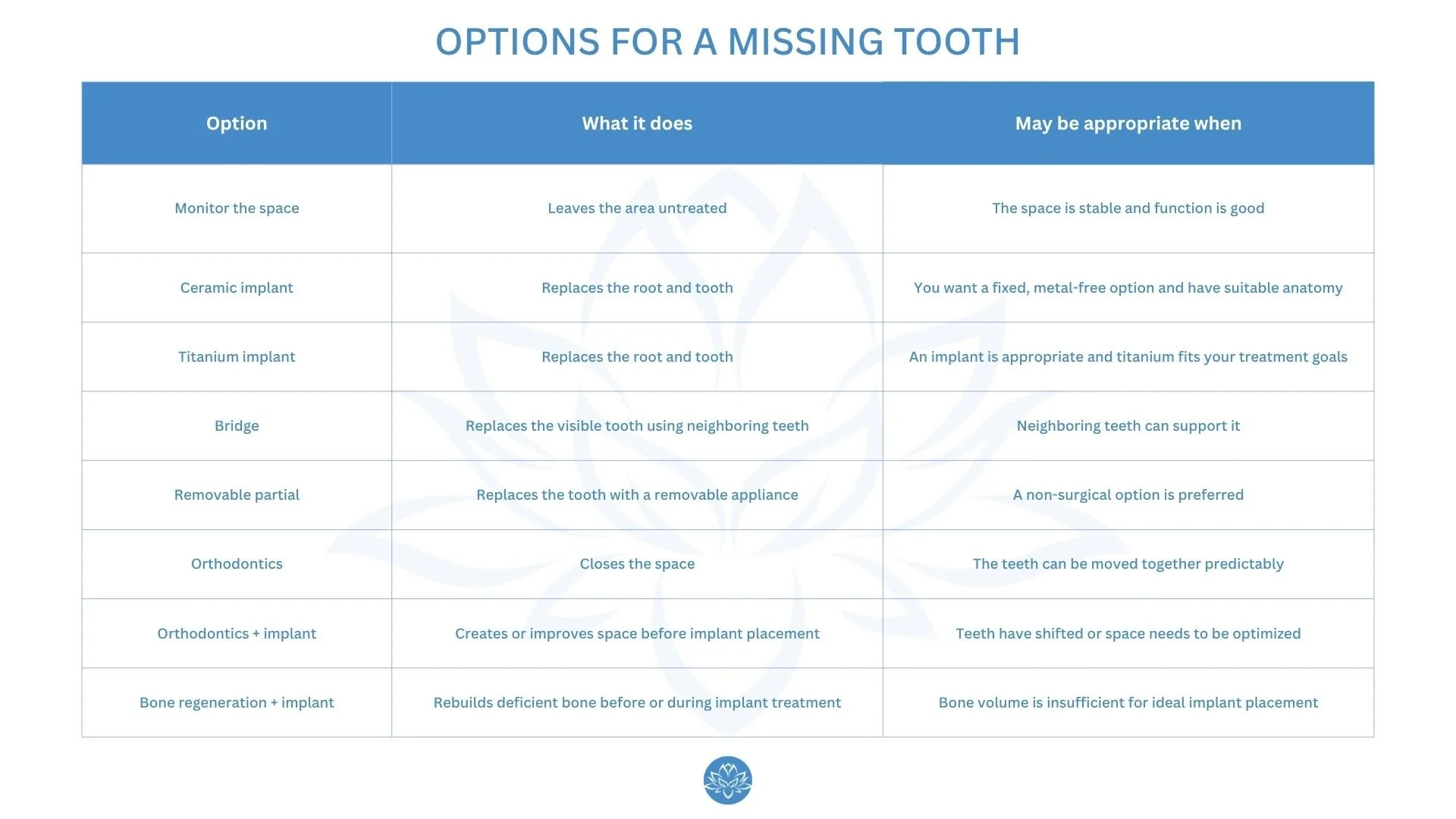
The right answer depends on you.
Missing a Tooth for Years? Start With an Evaluation, Not an Assumption.
If you've been living with a missing tooth for years, you aren't necessarily too late for an implant.
And you don't necessarily need one.
The first step is understanding the condition of your bone, gums, surrounding teeth, bite, overall health, and the reason the tooth was lost.
At Lotus Dental Wellness in Lake Oswego, Oregon, we use a biological, whole-body approach to dental treatment, with an emphasis on individualized care and biocompatible materials.
For patients considering dental implants, ceramic zirconia implants offer a metal-free option that may be particularly well suited to a biological approach.
But our goal isn't to sell you an implant.
Our goal is to help you understand your options and choose the treatment that makes the most sense for your health.
Explore Ceramic Dental Implants at Lotus Dental Wellness
Frequently Asked Questions About Missing Teeth
Can you get a dental implant years after losing a tooth?
Yes, often. Having a tooth missing for years does not automatically disqualify you from getting a dental implant. Bone loss or changes in the position of surrounding teeth may mean that additional treatment, such as bone regeneration or orthodontics, is needed first.
Is it bad to leave a missing tooth untreated?
Not necessarily. Some people can function well with a missing tooth, particularly depending on its location and their overall bite. However, bone loss, tooth movement, and changes in chewing can occur over time. An evaluation can help determine whether monitoring the space is reasonable for you.
What is the best replacement for a missing tooth?
There is no single best option for everyone. Options include ceramic or titanium implants, bridges, removable partial dentures, orthodontic space closure, orthodontic treatment followed by an implant, or monitoring the space.
Are ceramic dental implants better than titanium?
Ceramic and titanium implants are both used successfully in implant dentistry. Titanium has a much longer clinical track record, while zirconia offers a metal-free alternative that is increasingly supported by clinical research. Recent research continues to evaluate the long-term comparative performance of the two materials.
For patients specifically interested in biocompatibility and a metal-free approach, ceramic implants may be worth discussing with a biological dentist.
Can clear aligners fix a missing tooth?
Clear aligners cannot create a tooth where one is missing, but they can sometimes close the space or move surrounding teeth to create the appropriate space for a dental implant. Whether clear aligners are appropriate depends on your individual bite and anatomy.
Do I need a bone graft for a dental implant?
Not necessarily. It depends on the amount and shape of bone available at the implant site. A CBCT can help your dentist determine whether there is enough bone for the planned implant or whether bone regeneration may be beneficial.
What if my teeth have shifted into the space?
Orthodontic treatment may be able to reposition the teeth. In some cases, the space can be closed. In others, orthodontics can create the appropriate space for a future dental implant.
What should I ask a biological dentist about a missing tooth?
Ask:
Why did I lose this tooth?
What is happening to the bone?
Has my bite changed?
Are my neighboring teeth moving?
Do I have enough bone for an implant?
What materials are available?
Is a ceramic implant appropriate for me?
Would orthodontics improve my options?
Do I need bone regeneration?
How does my overall health affect healing?
What are my alternatives if I don't want an implant?
A good treatment plan should answer those questions before you commit to a procedure.
Sources & Further Reading
For patients who want to go deeper, these are the resources I'd link rather than loading the article with technical citations:
IAOMT: Introduction to Biological Dentistry
IAOMT: Oral Health Integration and Biological Dentistry
IAOMT: Ceramic Implants and Treatment Alternatives
Swiss Dental Solutions: Biological Dentistry and Swiss Biohealth Concept
2026 systematic review: Zirconia vs. titanium dental implants
Systematic review: Bone augmentation for dental implant placement